

How AI Borrowing Is Reshaping the Bond Market
In this post, we discuss how hyperscaler’s AI-driven borrowing supply wave is impacting the composition and pricing of the bond market. Learn more below.
In August, we put the 2026 hyperscaler AI CAPEX spend into context. Much of that spending comes from cash flow, but these companies are increasingly borrowing to fund it, and that borrowing is reshaping the investment grade bond market. I thought it would be interesting to look at how this borrowing supply wave is impacting the composition and pricing of the bond market.
Shifting Market Supply Results from Issuance of Hyperscaler Debt
Over the last two years Alphabet, Amazon, Meta, Microsoft, and Oracle* (referred to as ‘hyperscalers’), have grown the amount of borrowing they do via the investment grade bond market. Vanguard data estimates that issuance of hyperscaler debt has more than tripled from an annual average of $35 billion from 2020-2024 to more than $130 billion in the first seven months of 2026. JP Morgan forecasts about $200 billion for the full year 2026 and further growth into 2027.
*Alphabet, Microsoft, and Oracle are currently held in the Peak Model Stock Portfolio. The Model Portfolio is not a real cash portfolio. It represents the core direction of our portfolio management strategies. Individual client portfolios are managed in accordance with the clients’ specific objectives and constraints. Historical information is available upon request.
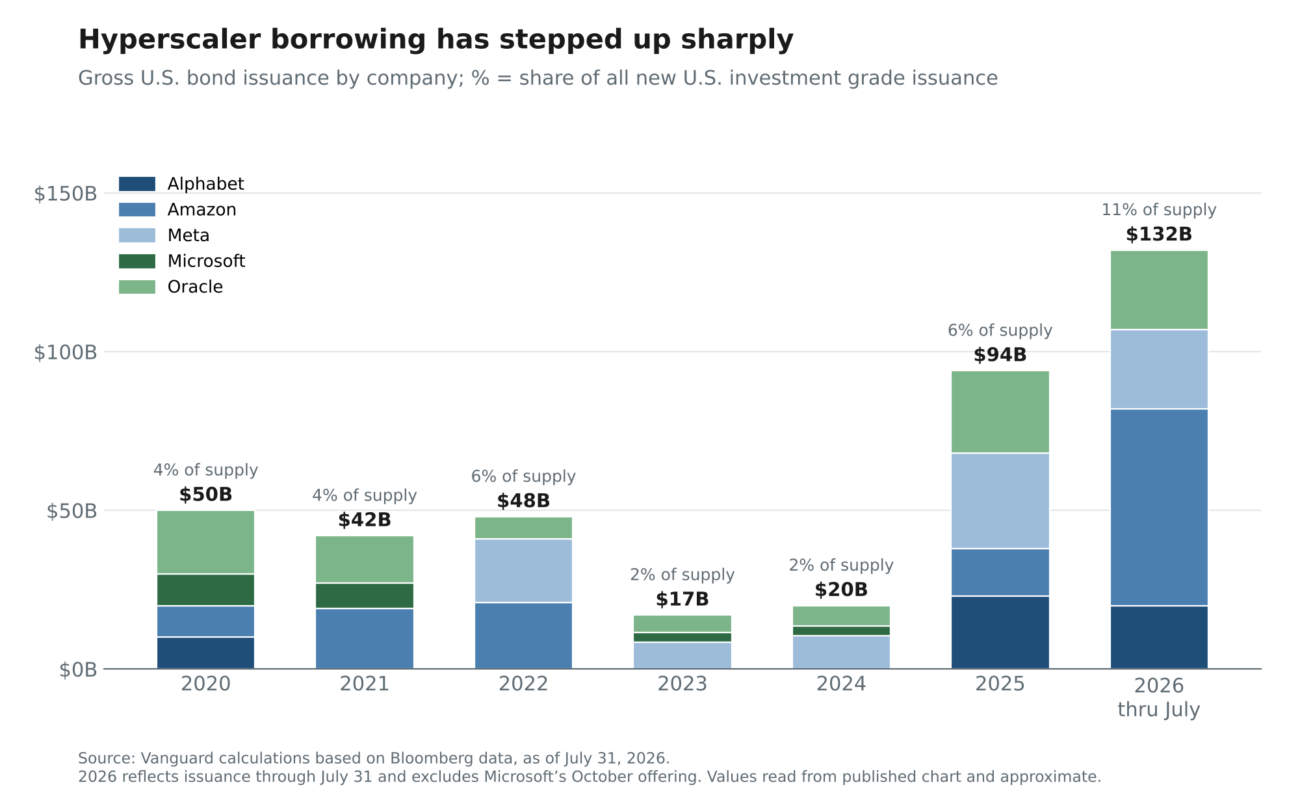
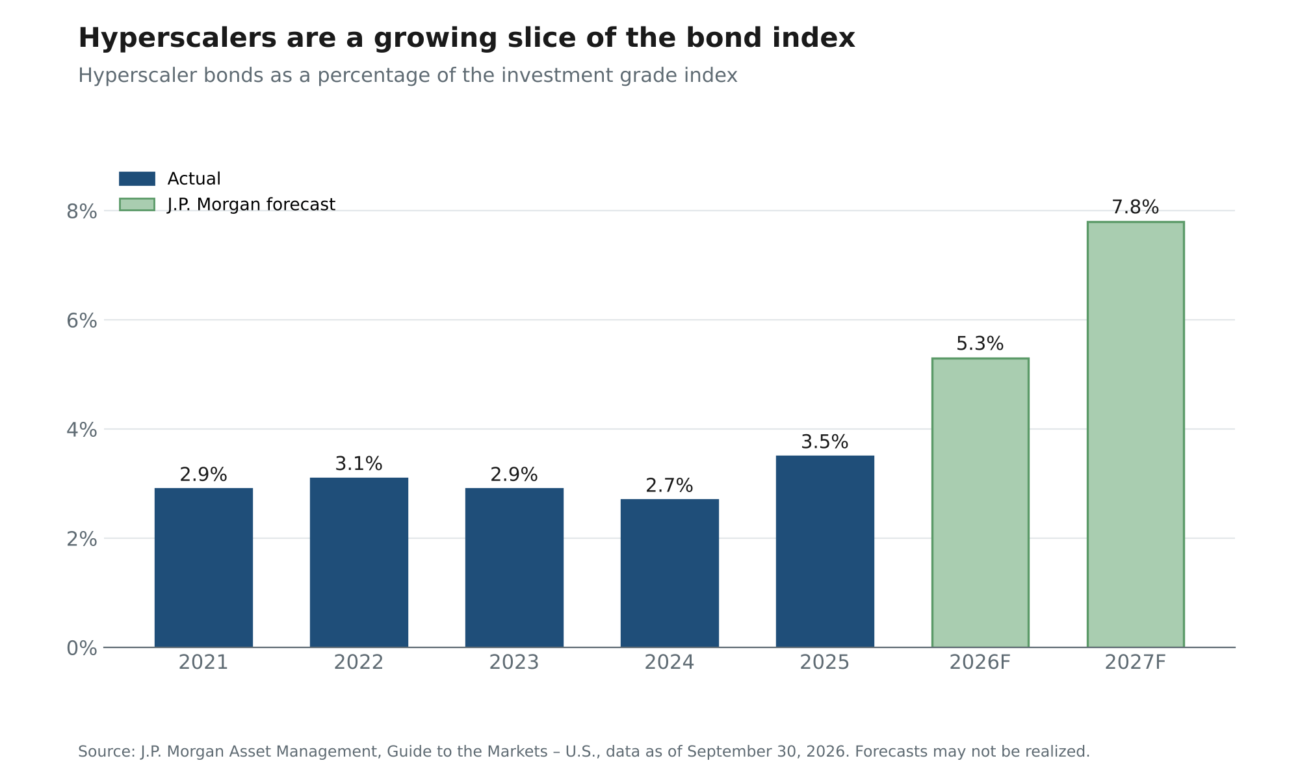
This enhanced supply is growing the ‘slice’ of hyperscaler bonds in the investment grade corporate bond pie. Their share of new investment grade supply has more than doubled. As a result of this, these bonds represent an increasing portion of the investment grade bond index from about 3% in 2021–2024 to a forecasted 5.3% in 2026 (JP Morgan).
Bond Spreads Increasing as Supply Comes to Market
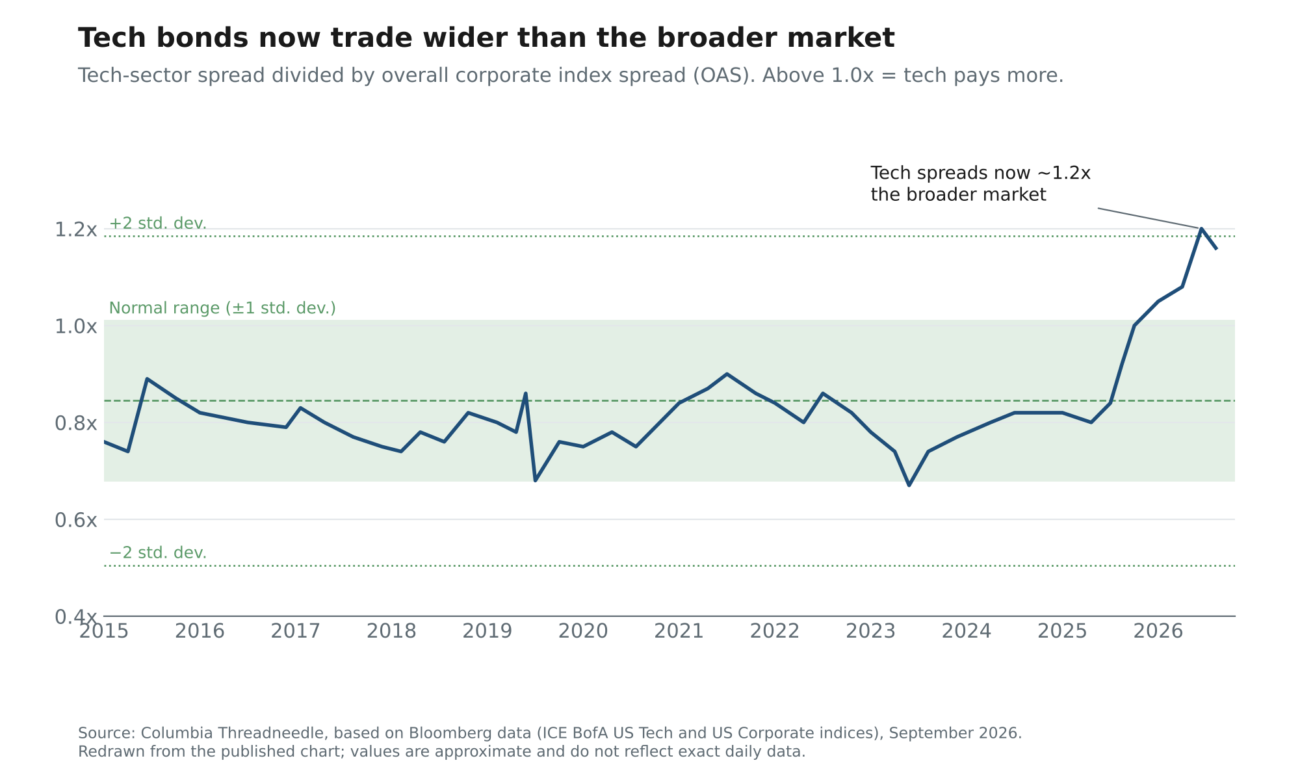
As measured by bond “spreads” (or yield differentials between corporate bonds and benchmark treasury bonds), market participants have demanded an increased yield for tech bonds as their issuance has increased. All else equal; wider spreads mean higher yields and lower bond prices. Spreads can widen due to relatively heightened risk, increased supply, or other factors.
Clues as to which might be the leading actor in creating spread widening can be found in looking at spreads on a relative basis. The chart below from Columbia Threadneedle Illustrates that from 2015 to 2025, spreads for tech issued bonds were trading at lower spreads than the broad corporate bond market. That flipped for the first time in late 2025, when tech spreads moved above corporate market spreads.
As it currently stands, all five of these companies have investment grade credit ratings, and four of the five have at least double AA credit ratings at S&P Global. Oracle is the exception. In July, S&P downgraded it to BBB-, the lowest investment grade rating. Microsoft maintained its AAA credit rating when it raised $25 billion in bonds in October 2026. JP Morgan estimates hyperscalers’ aggregated leverage, measured as net debt to trailing 12-month EBITDA, was 1.3x as of 2Q 2026—roughly half the 2.7x median for the investment grade corporate market (JP Morgan).
If weaker credit were the only driver of increasing relative spreads, one might expect to see it reflected in declining credit ratings and deteriorating balance sheets across the wider group. Since that is generally not the case, we look to increased supply as another possible driver. Portfolio managers may be unable to fully absorb the amount of bonds coming to market due to limits on the amount of an individual company, sector, or risk profile that they can own.
Sign of the Times: AI Spending Now Shows Up in Fixed Income Markets
It isn’t unusual that companies looking to expand would take on debt to do so. That AI spending now shows up in fixed income markets is a sign of the times and a demonstration of how central it has become. We continue to expect companies to raise capital via debt and other avenues and will be monitoring the implications of this as the situation evolves.
Disclosures
Advisory services offered through Peak Asset Management, LLC, an SEC-registered investment adviser. Registration does not imply a certain level of skill or training. The opinions expressed and material provided are for general information only and should not be considered a solicitation for the purchase or sale of any security. Clients and associated persons of Peak Asset Management, LLC may hold positions in the securities discussed in this content. Investing involves risk, including the possible loss of principal. Past performance is not an indication of future results. All strategies and services described involve risks, tax implications, and potential limitations, and may not be appropriate for every investor. Investors should consider these factors carefully before making decisions. The information in this material is not intended as tax or legal advice. Please consult legal or tax professionals for specific information regarding your individual situation. Copyright © 2026 Peak Asset Management, LLC.
The data included is believed to be accurate, but there is no guarantee of its accuracy, completeness, or timeliness. Charts and graphs in this blog were generated by Claude.


