

Why Are Interest Rates Rising?
The 10-year US Treasury yield recently crossed above 5.25%, a yield that we have not seen for 10-year government debt since 2007.
Interest rates, such as the yield on a 10-year US Treasury note, are an important backbone of the global economy, serving as a benchmark from which other bonds and credit instruments are priced. As yields rise, the cost to borrow money effectively increases. If yields rise too far or too fast, economic growth may slow or even contract.
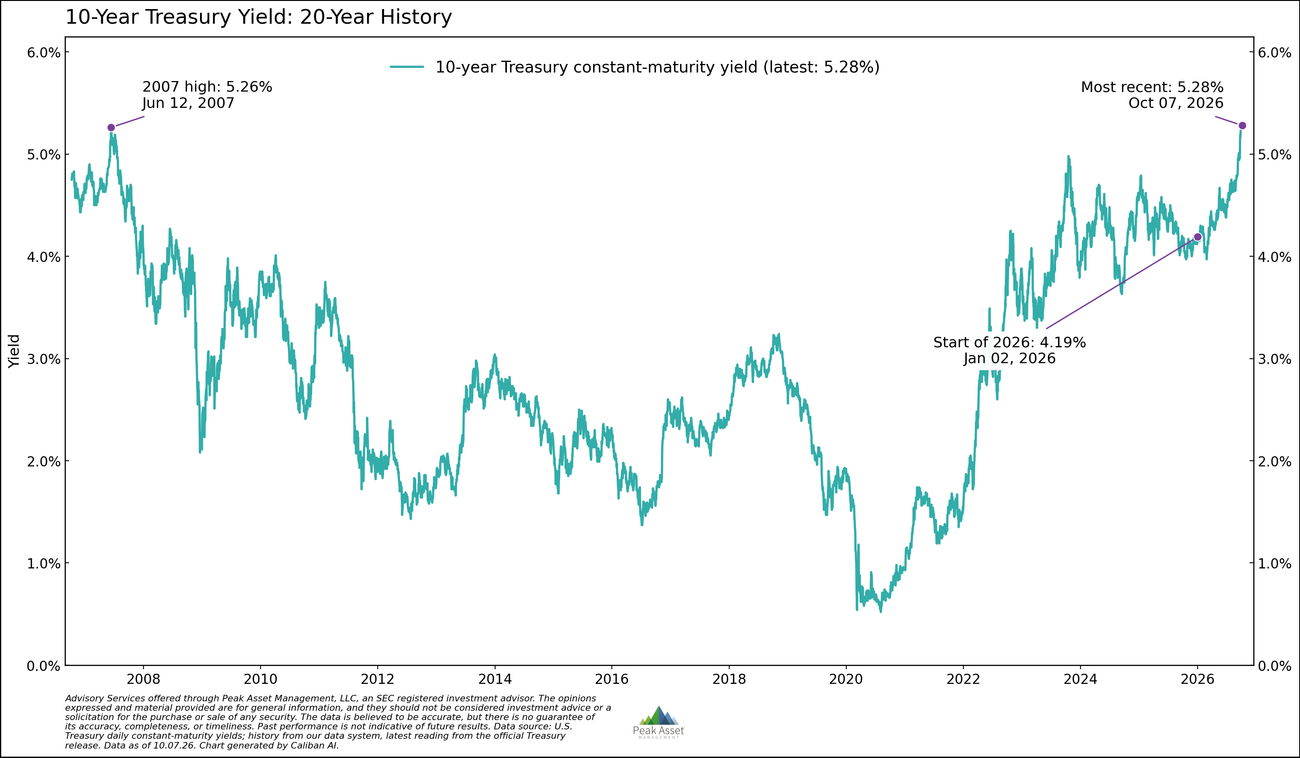
However, higher interest rates are not necessarily “bad” in and of themselves. Any basic economic model has to factor in both supply and demand – it could be that interest rates are rising because there is a tremendous amount of demand for capital to build things and grow the economic pie, which is driving a wave of new bond supply that must compete for a finite pool of savings, and the price of that competition is higher yields.
The economy is a vast and complex system, so it’s challenging to draw a direct causal relationship between any one variable and how it might impact the level of interest rates. However, we can speculate on a handful of reasons as to why interest rates are higher today, using the 10-year Treasury as an example, than at any other point in nearly 20 years.
What Drove September’s Spike
Continuing with our focus on the 10-year Treasury, yields recently spiked from 4.75% on August 31st to 5.29% on September 30th. Over a one-month period, that is a significant increase in rates. Likely causes for this move tie back to rising oil prices, ongoing inflationary pressures, the recent 0.25% increase in the Federal Reserve’s policy rate, strong manufacturing PMIs, and indications of strong GDP growth based on the latest estimates from the U.S. Bureau of Economic Analysis.
The Long View: Growth and Rates
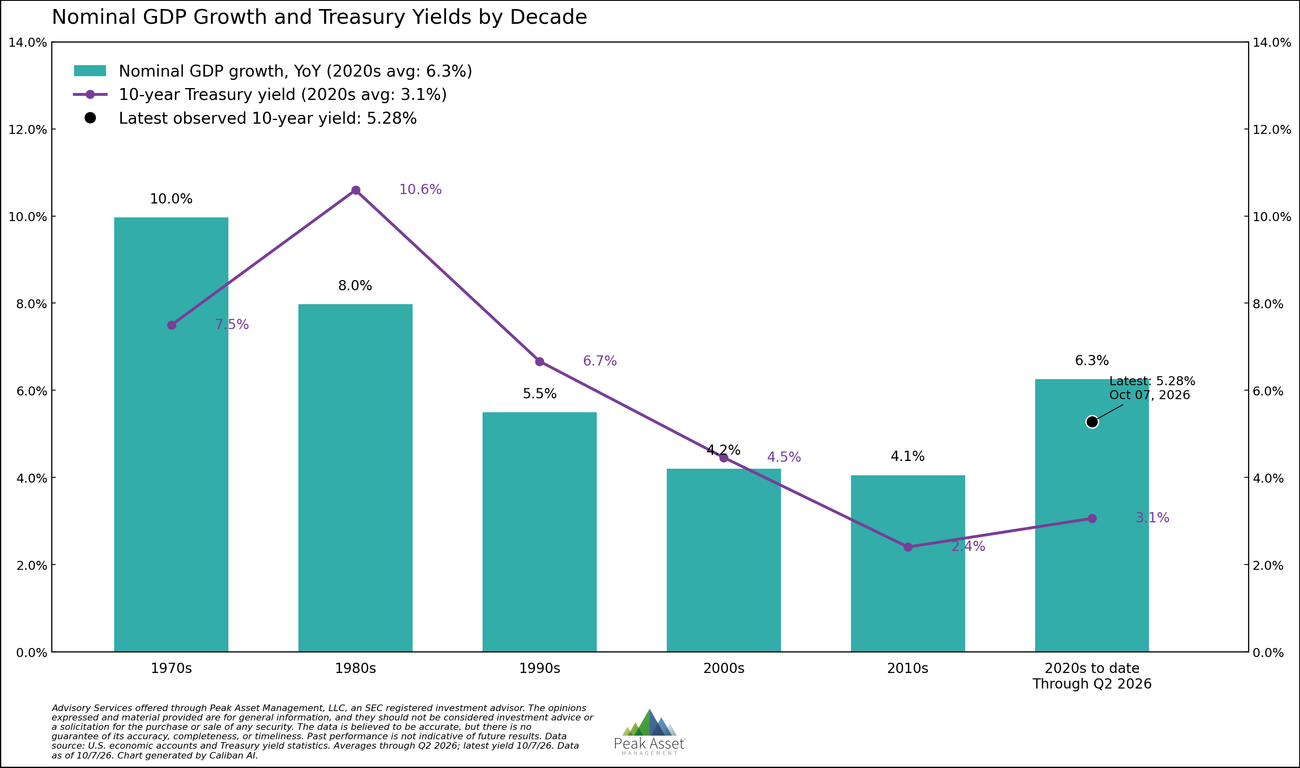
At the 30,000-foot view, we can also back into a few reasons why interest rates are higher today compared to most periods over the last two decades. For starters, nominal GDP growth has been strong in the 2020s. There are many factors that go into nominal growth, inflation being key, but we can compare nominal growth across decades and observe a positive correlation over long periods of time between average nominal GDP growth and the average level of the 10-year Treasury yield.
The chart below demonstrates this phenomenon in broad brush strokes. Since the 1980s, interest rates had been in a secular decline while nominal GDP growth was also decelerating. As nominal GDP growth has rebounded higher in the 2020s decade, so too have interest rates.
These economic variables are quite volatile, the relationship between them can shift across policy regimes, and the current level of interest rates says more about future expectations for inflation and growth than backward-looking GDP. But over long periods, strong nominal GDP growth has tended to coincide with firmer levels of interest rates.
The Lingering Effects of the 2020s Shocks
The economy has also experienced several shocks in the 2020s decade thus far, the COVID pandemic and subsequent policy responses being chief among them.
These are factors we can point to that might explain why nominal GDP growth, at least thus far, has been higher in this decade relative to the 2010s. A mix of fiscal deficits and stimulative monetary policy interventions, combined with rising levels of business investment in the real world, have contributed to the highest level of average nominal GDP growth since the 1980s.
In the chart below, we plot the average level of four macroeconomic variables by decade to compare their differences between the 2020s and the 2010s:
- Federal deficits as a percentage of GDP
- Year-over-year growth in the money supply
- Headline inflation based on CPI
- Business investment as a percentage of GDP
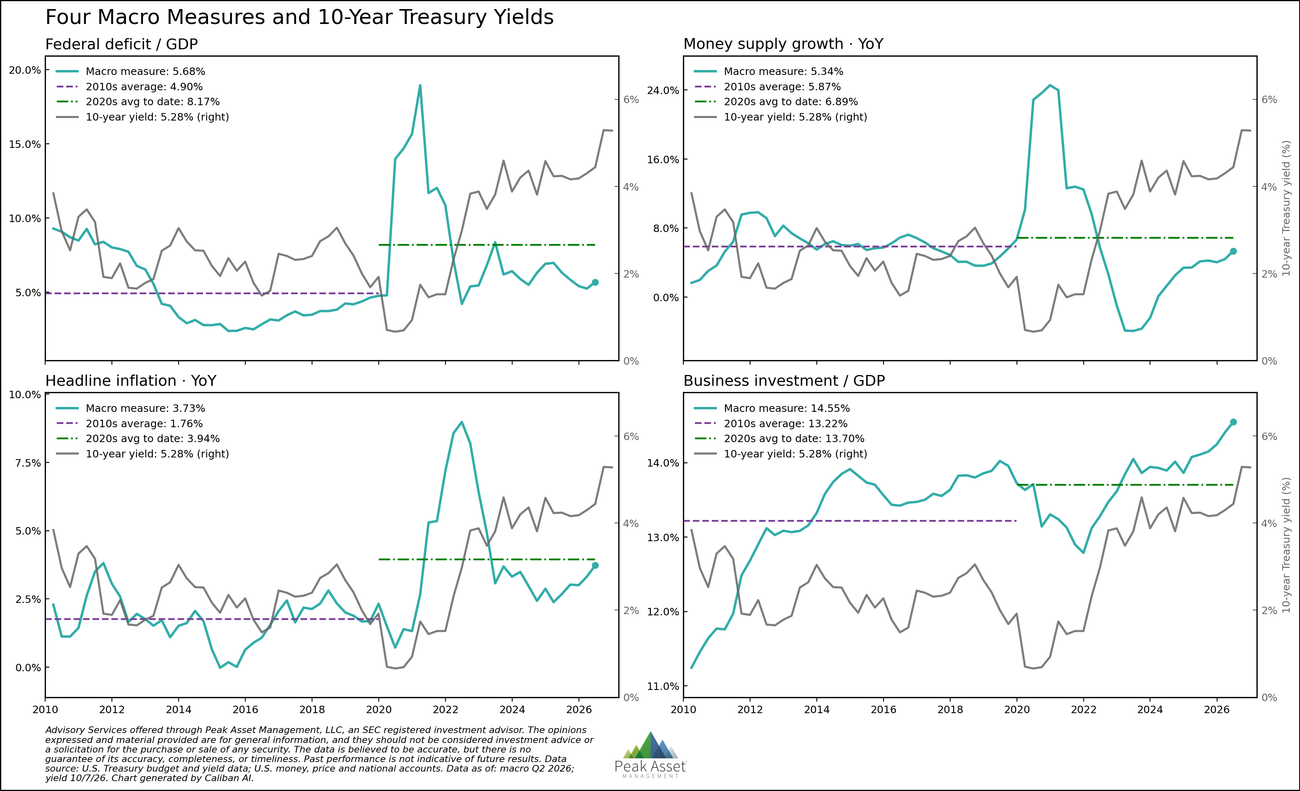
All four of these macroeconomic measures have been higher on average in the 2020s compared to the 2010s. The policy response to COVID was a significant shock to the economy, and it’s reasonable to think that we are still working through those shocks. Even as annual readings for deficits have cooled, years of elevated deficits have left a larger stock of government debt for investors to absorb.
And while inflation has come down from its peak, it is still running well above its 2010s’ pace, which may lead bond investors to demand more compensation for holding longer-term debt. Against that backdrop, higher yields are not particularly surprising.
The AI Investment Cycle
Moreover, we are in the midst of a historic investment cycle in artificial intelligence and data centers. The demand for capital and investment spending is showing up in GDP statistics and is having an impact on the growth trajectory of the US economy. On the chart above, that feeds into private nonresidential fixed investment as a percentage of GDP (bottom right panel) hitting the highest levels we’ve seen since at least 2010.
What Higher Yields Mean for Bond Investors
If you are an investor with savings to allocate across various asset classes, there is a bright side to higher interest rates.
For the first time in a long time, interest rates are back in a neighborhood that offers a higher starting yield than at most points since 2007. Interest rates could go even higher, which would put downward pressure on the price of bonds, but – at today’s levels – bond investors have relatively more income to offset potential price declines.
Two Time Frames
It helps to think about the level and direction of travel for interest rates over two distinct time frames. On a shorter time frame, oil prices, inflation data, and a Federal Reserve rate hike can explain some of the jump in Treasury yields that we witnessed in September. On a longer time frame, structural forces like stronger nominal GDP growth, a larger stock of government debt, and a capital-hungry investment cycle help explain why yields have reset above their 2010s levels. Interest rates may be volatile in both directions over the near term, but it’s the structural forces that are more likely to shape how rates move over multi-year horizons.
Disclosures
Advisory Services offered through Peak Asset Management, LLC, an SEC registered investment advisor. The opinions expressed and material provided are for general information, and they should not be considered a solicitation for the purchase or sale of any security. Investing involves risk, including the possible loss of principal. The information in this material is not intended as tax or legal advice. Please consult legal or tax professionals for specific information regarding your individual situation. All strategies and services described involve risks, tax implications, and potential limitations, and may not be appropriate for every investor; clients should consider these factors carefully before making decisions. This content is developed from sources believed to be providing accurate information and may have been developed and produced using resources from a third party to provide information on a topic that may be of interest. This third party is not affiliated with Peak Asset Management. It is not our intention to state or imply in any manner that past results are an indication of future performance. Copyright © 2026 Peak Asset Management
Deprecated: Creation of dynamic property SocialHelper::$postId is deprecated in /home2/hztqwjmy/public_html/wp-content/themes/peak-wp-theme/inc/social-helper.php on line 9


