

Quarterly Client Letter: Q3 2026
The Federal Open Market Committee approved the following statement for release by a 12 – 0 vote: “The Committee decided to raise the target range for the federal funds rate by 1/4 percentage point to 3-3/4 to 4 percent, in support of the Federal Reserve’s dual mandate.”
Federal Reserve FOMC statement
September 16, 2026
* * * * * * *
| Market Index | Q3 2026 Return | Year-to-Date Return Through Q3 |
| U.S. Stocks (S&P 500) | 2.30% | 12.75% |
| The Average Stock (S&P 500 Equal-Weight) | -1.87% | 10.03% |
| U.S. Bonds (Bloomberg U.S. Aggregate Bond Index) | -3.51% | -2.91% |
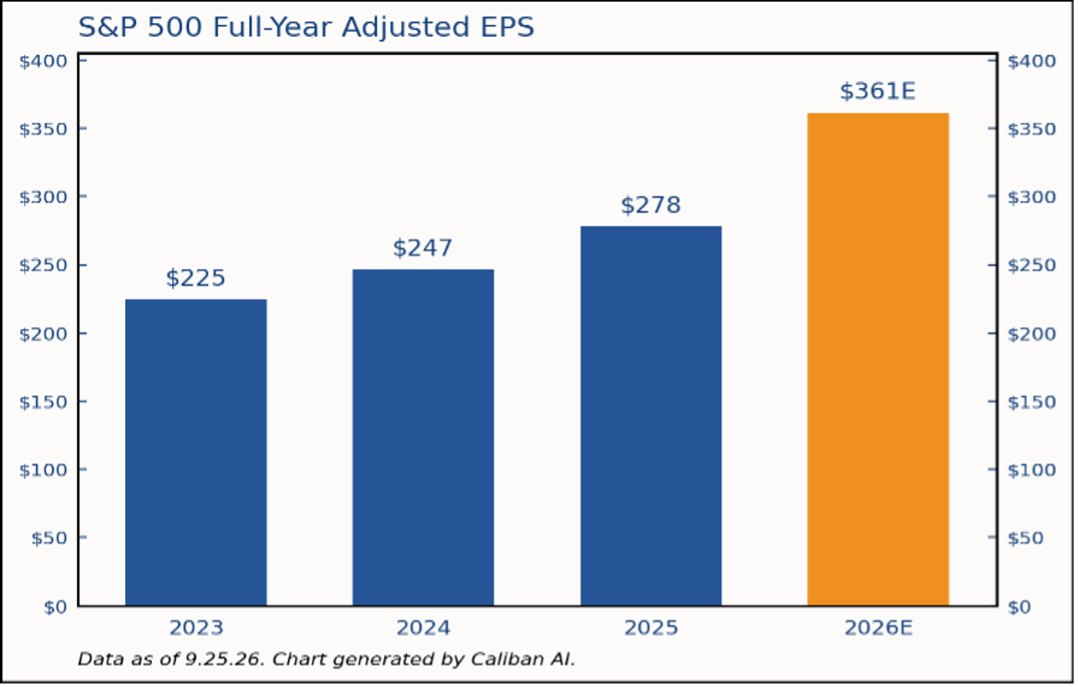
The U.S. stock market continued its upward momentum in the third quarter of 2026. Strong earnings growth helped propel the S&P 500 to a record high in August (followed by a fresh all-time high on October 7th). Impressively, as I write this letter, on October 12th the market completed its fourth year in this bull run. However, looking beneath the surface reveals a divergence within the stock market. While large-cap technology leaders kept the broader index positive, the average stock, as reflected in the S&P 500 Equal-Weight Index, actually lost ground during the quarter. Meanwhile, rising interest rates put pressure on bond prices.
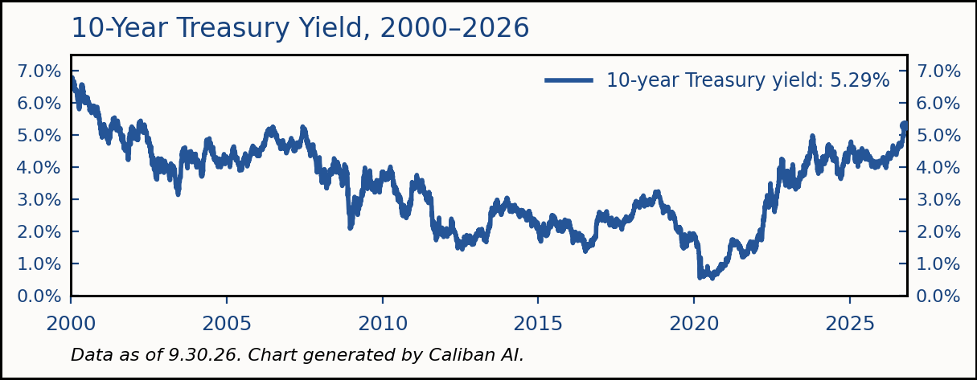
On September 30th, the yield on the 10-Year U.S. Treasury hit 5.3% — a level we have not seen since 2007, just before the Great Financial Crisis. Historically, a bond’s starting yield-to-maturity has been a strong indicator of its future return. From my perspective, fixed income looks more attractive than it has in many years!
Why we see value in bonds today:
- A Larger Income Cushion: While longer-term bond prices fluctuate when interest rates move, today’s higher interest income provides an attractive safety cushion in a balanced portfolio.
- Diversification Benefits: Historically, bonds have functioned as a stabilizer, often moving up when stocks go down. Higher starting yields improve that defensive dynamic. Over the last 50 years, the S&P 500 had nine negative years and bonds, as measured by the Bloomberg U.S. Aggregate Bond Index, were positive in eight of them (though just barely in 2018). The only exception was in 2022, when starting yields were near historic lows of just 1.5% on the 10-Year Treasury.
- Income, Liquidity, and Opportunity: Beyond diversification, bonds continue to provide reliable current income and liquidity. They also provide a dedicated source of funds to rebalance into stocks when prices decline.
* * * * * * *
In the quote that opened this letter, a united Federal Open Market Committee raised the overnight Fed Funds interest rate by a ¼ of a percent to a range of 3.75% – 4.00%. It was a good moment to help the new Fed Chair, Kevin Warsh, establish some credibility and independence. In the summary of its goals, the Committee included in its statement: “Inflation remains elevated. Today’s policy action will support a timelier return to the Committee’s 2 percent goal. The Committee will deliver price stability.” With the Two-Year Treasury yield climbing from 3.47% at the beginning of the year to 4.88% on September 30th, I believe the bond market has already done much of the Fed’s work. Now the Fed simply needs to follow.
* * * * * * *
We hope this letter finds you and your family well. We appreciate your business, and we continue to work hard to earn the trust that you have placed in us. Please let us know if you have a friend or a family member who could use our assistance.
John McCorvie, CFA
Advisory Services offered through Peak Asset Management, LLC, an SEC registered investment advisor. The opinions expressed and material provided are for general information, and they should not be considered a solicitation for the purchase or sale of any security. The information in this material is not intended as tax or legal advice. Please consult legal or tax professionals for specific information regarding your individual situation. This content is developed from sources believed to be providing accurate information and may have been developed and produced by a third party to provide information on a topic that may be of interest. This third party is not affiliated with Peak Asset Management. It is not our intention to state or imply in any manner that past results are an indication of future performance. Copyright © 2026 Peak Asset Management


