

Financial Intelligence Newsletter for Q3 2026
Welcome to our latest newsletter, where we continue our commitment to comprehensive financial planning for our clients and their families. At Peak, we believe that thoughtful retirement and tax planning, business succession planning, estate and legacy planning, and equity compensation planning strategies are not separate exercises, but interconnected pieces of a single, coordinated plan. A decision made in one area — the timing of a Roth conversion, the structure of a buy-sell agreement, or the exercise of employee stock options — has ripple effects across the others, which is why we actively consider how a recommendation in one domain supports your broader financial picture. We welcome the opportunity to work alongside you as your circumstances evolve, and we encourage you to reach out with questions about your finances, taxes, or estate plan.
In this issue, we’re pleased to feature two articles from members of our financial planning team. Bethany Aylor examines the newly introduced Trump Accounts, exploring how they work and how they may benefit clients and their children. She compares Trump Accounts against more familiar savings vehicles, such as 529 plans, traditional brokerage accounts, and Roth IRAs, weighing the pros, cons, and tradeoffs of each. Her article takes a deep dive into the tax treatment, contribution limits, investment restrictions, withdrawal rules, and account structure governing these new Trump Accounts, along with the situations and circumstances in which we might recommend one to a client.
Grant Bugner then turns to the Mega Backdoor Roth, a strategy worth considering for wage earners who have already maxed out their 401(k) contributions. Grant defines the technique, explains when it can be utilized, and outlines the requirements involved, whom it tends to suit best, and how to execute it properly, while also candidly addressing the challenges and pitfalls that can arise along the way. Bethany and Grant are both happy to answer any follow-up questions you may have.
Trump Accounts Are Live: What Families Need to Know Now
By Bethany Aylor, CFP®, EA
Earlier this year, we introduced you to the Trump account, a new tax-advantaged savings vehicle for children created under recent federal legislation. At the time, many of the program’s details were still taking shape. Trump accounts officially launched on July 4, 2026, and the program has moved quickly from concept to reality. The investment lineup has been announced, the account-management app is live, and millions of families have already signed up. If you opened an account for a child or grandchild earlier this year, or if you have been waiting to see how the program would unfold before deciding, this is a good time to revisit where a Trump Account may fit into your broader financial plan.
A Quick Refresher: What Is a Trump Account?
A Trump account is a tax-advantaged investment account established for a child under age 18 (children turning 18 in the current year are not eligible to open a new account). Parents or guardians open the account by filing IRS Form 4547 or through the TrumpAccounts.gov online portal. Children born between 2025 and 2028 may also receive a one-time $1,000 seed contribution from the U.S. Treasury, though this must be proactively elected.
Here is a recap on the core mechanics:
- Tax treatment. Investments grow tax-deferred, similarly to a non-deductible IRA. Some contributions create tax basis, while investment growth and other contributions are treated as pre-tax and taxable upon distribution. Understanding future taxation on withdrawals is an important planning consideration.
- Contribution limits. Total annual contributions from family, friends, the child, and employers combined are capped at $5,000 per child, and must be made by December 31 to count for that tax year. This limit will be indexed for inflation starting in 2027.
- Employer contributions are capped at $2,500 per employee, per year.
- Contributions from government sources (federal, state, and local) and charitable organizations do not count toward the $5,000 cap, have no annual dollar limit, and do not increase the account’s tax basis.
- Investment restrictions. Until the child turns 18, investments are limited to exchange-traded funds or mutual funds tracking a broad U.S. equity index, with expenses capped at 0.10%.
- Withdrawal rules. Withdrawals are prohibited until January 1 of the year when the child turns 18. Early withdrawal penalties apply before age 59 ½, with limited exceptions.
- Account structure. Each child may have only one Trump Account. Parents or guardians manage the account until the child reaches adulthood. Bank of New York Mellon serves as the initial custodian, with Robinhood providing the trading platform and technology.
What’s New Now That Accounts Are Live
Since our last update, the Treasury has filled in some of the details families were waiting for:
The investment lineup has been announced. At launch, all contributions default into the State Street SPDR Portfolio S&P 500 ETF (SPYM), chosen for its broad market exposure and low cost. The Treasury has since added four additional low-cost, broad-based index options to the approved lineup: the iShares Core S&P 500 ETF (IVV), the Vanguard Total Stock Market ETF (VTI), the State Street SPDR Portfolio S&P 1500 Composite Stock Market ETF (SPTM), and the iShares Core S&P Total U.S. Stock Market ETF (ITOT). All five funds fall within the statutory 0.10% expense cap. For now, new contributions still flow into the default fund. But the Treasury has indicated that parents and guardians will be able to actively choose among the five options in the coming months. Stay tuned for further instructions.
Adoption has been substantial, but uneven. More than six million children have been enrolled since the program opened for sign-ups. However, only a portion of children eligible for the $1,000 Treasury seed contribution, those born between 2025 and 2028, have actually claimed it, since enrollment requires families to proactively opt in. Treasury data through midyear also showed that the large majority of accounts opened were linked to households earning under $200,000, though policy researchers have noted that lower-income families, who may have the most to gain, are statistically less likely to file the tax paperwork needed to enroll without prompting.
Portability is coming, but not yet available. The Treasury has confirmed that Trump Accounts will eventually be transferable to other approved financial institutions—any IRA custodian already approved as of the end of 2025 is automatically eligible to receive rollovers. The specific mechanics and forms for these rollovers have not yet been released, so for now, accounts will remain with the initial custodian.
How Trump Accounts Compare to Other Savings Vehicles
Trump Accounts now compete for your family’s savings dollars alongside education-focused 529 plans, flexible custodial accounts (UGMA/UTMA), and retirement vehicles like Roth IRAs. Each account type carries its own rules, tax treatment, and ideal use case, and the right answer for your family often involves a combination rather than a single choice.
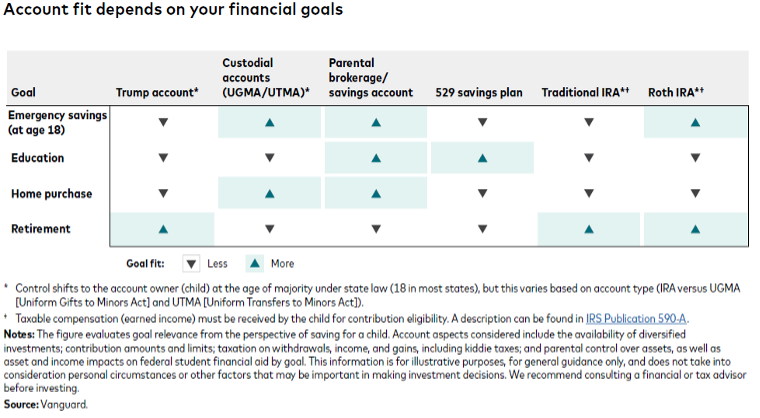
The comparisons below from Vanguard illustrate how these accounts stack up depending on your goals and the features that matter most to your planning.
When a Trump Account May Make the Most Sense
While Trump Accounts do not replace other planning tools, there are situations where they may add meaningful value.
Families uncertain about their child’s future path. Some parents aren’t sure whether a child will pursue college, a trade, entrepreneurship, or something else entirely. Because a Trump Account isn’t tied to educational use, it can serve broader, longer-term objectives than a dedicated education savings account. Like an IRA, there are tax consequences and penalties for early withdrawals, so this is best viewed as a long-term holding—but unlike an IRA or Roth IRA, the child does not need earned income for contributions to be made.
Families looking to start investing early. The $1,000 government seed contribution can be a meaningful nudge for families who might not otherwise begin saving for a child right away. In most cases, families likely will benefit from claiming this basic contribution, and even modest ongoing contributions could potentially benefit from years of compounding. While starting early may be advantageous, all investing still involves risk, including the possible loss of principal.
Grandparents and extended family. Because third parties may contribute, grandparents and other relatives building a family legacy strategy may find Trump Accounts appealing. When multiple people plan to contribute to the same account, coordinating in advance is key—the $5,000 annual cap applies in aggregate across all contributors.
Households already maximizing other accounts. For higher-income families already fully funding 529 plans and Roth IRAs where eligible, a Trump Account offers an additional tax-advantaged savings avenue.
Business owners looking to support employees. With the Treasury actively promoting the employer-contribution feature, business owners may want to evaluate whether contributing to employees’ children’s accounts fits within their broader compensation and retention strategy.
Planning Consideration: Roth Conversion Timing
One tactical planning opportunity we continue to watch is the timing of a future Roth conversion, which can generally happen once the child reaches age 18 or 24.
At age 18, children may still be subject to the kiddie tax, which could reduce the efficiency of a conversion. For 2026, a child could absorb $2,700 of income on their own return before parental rates apply—the first $1,350 is tax-free, and the next $1,350 is taxed at the child’s own rate, typically 10%. Anything over $2,700 is taxed at the parent’s marginal rate, which may not make an early conversion attractive.
Waiting until age 24 clears the kiddie tax hurdle entirely, allowing the full conversion to occur at the child’s own income tax rates, often a lower bracket than the parents faced at age 18, depending on the child’s earnings at that point. Any after-tax contributions previously made to the account are converted tax-free, further cushioning the taxes due. Spreading a conversion across multiple years—for example, ages 24, 25, and 26—can also help manage the tax impact.
Key factors to weigh include:
- The parents’ tax bracket when the child turns 18
- Whether parents are willing to cover taxes on the child’s behalf
- The child’s expected income at 24 and beyond
- Broader retirement planning goals for the child
Planning takeaway: The right conversion timing depends more on tax coordination across the family than on age alone. We would be happy to help you think through the sequencing as your child’s situation develops.
Final Thoughts
Trump Accounts have moved from proposal to reality, and the program continues to take shape as the Treasury rolls out new features. Whether your priority is retirement savings, education funding, or building flexibility for the next generation, the most effective approach rarely comes down to a single account, it comes from coordinating the right mix of tools around your family’s goals. At Peak, we believe financial confidence starts with clarity. As the rules around Trump Accounts continue to develop, we’ll keep you informed on what matters most for your plan. If you’d like to talk through whether opening or funding a Trump Account makes sense for your family, we are here to help.
Already Maxing Your 401(k)? The Mega Backdoor Roth May Be Your Next Move
By Grant Bugner, CFP®
If you’re a high earner, there’s a good chance you’re already maxing out your 401(k), and potentially a Health Savings Account (HSA). Those are both effective steps that may support your long-term financial goals. But what if you still have substantial cash flow that you’d like to invest for growth?
Many high earners assume the next logical step is stacking contributions in a taxable brokerage account. While that might be the right strategy for some, others may have another viable option available: the Mega Backdoor Roth.
In 2026, employees under 50 are limited to $24,500 in regular 401(k) contributions. However, what many do not realize is that the actual maximum amount, including both employee and employer contributions, that can go into your 401(k) on an annual basis is $72,000 (for 2026).
So where does the other $47,500 go?
What Exactly Is a Mega Backdoor Roth?
You’re probably familiar with the two most common employee 401(k) contribution opportunities:
- Traditional: deductible today, taxable as ordinary income upon withdrawal.
- Roth: no up-front deduction, but tax-free upon withdrawal (assuming rules are met).
The above contribution types are subject to the $24,500 annual deferral maximum (for those under 50). Many do not realize that there is a third type of 401(k) contribution available: after-tax contributions. But isn’t that what a Roth contribution is? Yes and no.
After-tax contributions are similar to Roth contributions in that there is no tax deferral on the contribution. The difference is that after-tax contributions grow tax-deferred, not tax-free like Roth dollars. So, you’ll still owe ordinary income taxes on the earnings growth at the time of withdrawal.
Here is where the Mega Backdoor Roth comes into play. One could contribute $24,500 to their Traditional 401(k) to maximize the tax savings available. Then, the employee could contribute an additional $47,500 to the 401(k) on an after-tax basis, and immediately convert this same amount into their Roth 401(k).
Remember, the $72,000 limit also includes any employer contributions. So, if the employer contributes $10,000 to the 401(k), the employee’s allowable after-tax contribution amount is reduced to $37,500.
Here is a basic example for an employee under age 50:
| Employee pre-tax 401(k) contribution: | $24,500 |
| Employer match/profit sharing: | $10,000 |
| After-tax contribution capacity: | $37,500 |
| Potential Mega Backdoor Roth: | $37,500 |
The Two Requirements Your 401(k) Must Have
For a Mega Backdoor Roth conversion to be a possibility, your employer’s 401(k) plan MUST allow two provisions:
- After-tax contributions: remember, this type of contribution is NOT the same as a Roth contribution.
- A method to convert the after-tax contributions to Roth: this can be done via either an in-plan conversion to a Roth 401(k), or an in-service distribution to a Roth IRA.
If you’re unsure whether your plan allows either of the above, pull your Summary Plan Description or call your 401(k) provider to assess whether BOTH the above requirements are present.
Who Is the Mega Backdoor Roth Best Suited For
A Mega Backdoor Roth may be suitable for someone who:
- Already contributes the maximum to their 401(k)
- Has additional cash flow to invest
- Has fully funded their emergency reserves and any short to medium-term goals
- Wants to build tax-free retirement assets
- Has an employer plan that permits the strategy
Be aware that the Mega Backdoor Roth is a sophisticated savings strategy. Just because you may be maxing out your 401(k) doesn’t mean the Mega Backdoor Roth is the first place your next dollar should go. Be sure you have sufficient taxable savings to provide liquidity and flexibility for goals such as the buying of a home, paying for a wedding, or replacing vehicles. While the tax-free benefits of a Mega Backdoor Roth can be significant, the flexibility of tax diversification should not be ignored.
How to Execute a Mega Backdoor Roth
The execution of a Mega Backdoor Roth strategy can be broken down into three distinct steps:
Step 1: Calculate Your Available Capacity: To do so, start with the IRS limit of $72,000. Then, subtract your regular 401(k) contributions, any employer match, and any employer profit-sharing/non-elective contributions. The amount remaining is your theoretical after-tax contribution capacity.
Step 2: Make After-Tax Contributions: This is usually done through your workplace payroll provider’s website or application. Again, be certain that you select after-tax, not any Roth option.
Step 3: Convert the Dollars to Roth: Ideally, this step happens immediately after step 2, or as quickly as possible. Why? Once you make after-tax contributions, any growth on those contributions is taxable at the time of conversion. Converting quickly can minimize the amount of taxable growth created before the Roth conversion.
Some employer plans allow for the automation of Step 3. In other words, once you make after-tax contributions to your 401(k), the plan will automatically sweep/convert those contributions to your Roth 401(k), eliminating taxable growth on the initial contributions. It is certainly worth checking if this feature is available in your plan, which can simplify the process.
Final Thoughts
The Mega Backdoor Roth can be an effective, long-term savings strategy for some investors, but that doesn’t mean everyone should use it. You shouldn’t sacrifice liquidity or short-term goals simply to cram every possible dollar into retirement accounts. Yes, tax-efficiency and reducing your lifetime tax bill are very important, but tax diversification can be equally consequential.
Traditional (pre-tax), Roth, and taxable assets can be thought of in the following manner: Traditional assets give you a tax deduction today, Roth assets give you tax-free flexibility later, and taxable assets give you liquidity and flexibility throughout your wealth-building journey. The objective isn’t necessarily to maximize any one savings bucket. It’s to intentionally build all three.
Advisory Services offered through Peak Asset Management, LLC, an SEC registered investment advisor. The opinions expressed and material provided are for general information, and they should not be considered a solicitation for the purchase or sale of any security. Investing involves risk, including the possible loss of principal. The information in this material is not intended as tax or legal advice. Please consult legal or tax professionals for specific information regarding your individual situation. All strategies and services described involve risks, tax implications, and potential limitations, and may not be appropriate for every investor; clients should consider these factors carefully before making decisions. This content is developed from sources believed to be providing accurate information and may have been developed and produced by a third party to provide information on a topic that may be of interest. This third party is not affiliated with Peak Asset Management. It is not our intention to state or imply in any manner that past results are an indication of future performance. Copyright © 2026 Peak Asset Management


